QUICK ANSWER: Electronics manufacturing services (EMS) is a category of outsourced production where a contract manufacturer handles design, PCB assembly, testing, packaging, and repair of electronic products on behalf of a business. For B2B buyers, EMS providers bridge the gap between an idea and a finished, tested product ready for the market or internal deployment.
Most companies that hire an EMS provider think they’re buying assembly. They’re not. They’re buying a production pipeline that starts before a single component is placed and ends only after the finished unit clears testing and ships.
Here’s what that actually looks like when you break it down: engineering input at the design stage, material procurement from vetted distributors, SMT and through-hole placement, functional validation, and often repair and rework when something comes back from the field. Miss any of those links and the chain breaks.
For businesses that need electronic devices designed, built, or repaired without standing up their own factory floor, electronics manufacturing services represent the most practical path from concept to production-ready hardware.
What Electronics Manufacturing Services Actually Cover
EMS is not a single service. It’s a stack of capabilities that a contract manufacturer offers under one roof. How many of those layers a given provider can handle will determine how much coordination stays on your plate.
Engineering and PCB Design Support
Design for manufacturability (DFM) review is where serious EMS providers start. The goal is catching problems at the schematic and layout stage, before you’ve spent money on tooling or components. A good DFM pass looks at trace widths, pad geometries, component clearances, and thermal relief patterns on the printed circuit board layout.
PCB layout follows the schematic capture, usually done in tools like Altium Designer, KiCad, or Cadence Allegro. EMS providers that offer in-house PCB layout services can turn a functional prototype into a design file ready for fabrication within days, not weeks. That matters when you’re trying to hit a product launch window.
Component Sourcing and Bill of Materials Management
This is where a lot of first-time EMS buyers get surprised. Component procurement is not just buying parts. Authorized distributors like Arrow Electronics, Avnet, and Digi-Key carry the ICs, passives, connectors, and modules you need, but lead times on certain semiconductors can stretch six to twenty-six weeks depending on the market cycle.
An EMS provider with established distributor relationships can navigate allocation queues, identify approved substitutes, and flag obsolete parts before they end up in a bill of materials that can’t be fulfilled. That kind of supply chain visibility is something most in-house teams don’t have until they’ve been burned by a production halt.
The Manufacturing Process Step by Step
Once design is locked and components are on hand, production follows a defined sequence. The specifics vary by product complexity, but the core stages don’t change much across contract electronics manufacturers.
Surface Mount Technology Assembly
SMT assembly is the dominant process in modern PCB manufacturing. Solder paste gets screened onto the board through a stencil, pick-and-place machines set components at speeds measured in thousands of placements per hour, and the board passes through a reflow oven with a controlled temperature profile.
IPC-A-610, published by IPC (the Association Connecting Electronics Industries), sets the acceptance criteria for solder joints, component positioning, and surface finish. Certified IPC-A-610 specialists inspect boards against these standards at the end of the reflow process. That certification matters when you’re selling into regulated markets like medical devices or aerospace electronics.
Through-Hole Technology for High-Stress Applications
SMT gets most of the attention, but through-hole technology (THT) remains the right answer for connectors, power inductors, electrolytic capacitors, and components that carry mechanical load or handle significant heat. The lead goes through a drilled hole and gets soldered on the opposite side, creating a bond that surface mount simply can’t match in pull strength.
Wave soldering and selective soldering are the two production methods for THT. Wave soldering passes the board over a wave of molten solder; selective soldering uses a nozzle to hit specific through-hole joints without disturbing adjacent SMT components. Mixed-technology boards, meaning those with both SMT and THT parts, are common in industrial electronics, IoT devices, and power supplies.
Testing and Quality Assurance You Should Require
A board that looks good isn’t necessarily a board that works. Testing is non-negotiable, and the level of test coverage your EMS provider applies directly determines your field failure rate. I’d argue that skimping on test coverage is the most expensive mistake B2B buyers make with electronics manufacturing. You pay for it later, at a much higher per-unit cost.
In-Circuit Testing and Functional Testing
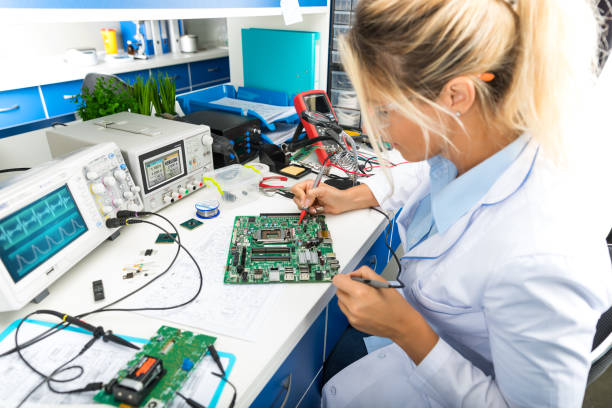
In-circuit testing (ICT) uses a bed-of-nails fixture or flying probe system to check individual components on the populated board, verifying resistances, capacitances, voltages, and digital logic states without running the device at full power. ICT catches opens, shorts, and wrong-value components that visual inspection misses.
Functional testing runs the completed assembly through its actual use case. A GPS tracker gets a signal lock test. A motor controller drives a load. A wireless module connects to a network. Burn-in testing, which runs units at elevated temperature or voltage for an extended period, screens out early-life failures before the product ships.
Environmental Stress Screening
Environmental stress screening (ESS) exposes boards to thermal cycling, vibration, or humidity to precipitate latent defects. MIL-HDBK-2164 and JEDEC standards define common ESS protocols for defense and commercial electronics respectively. For consumer products, ESS protocols are often derived from IEC 60068 environmental testing standards.
Repair and Rework Services
Even well-run production lines generate non-conforming product. And field returns happen regardless of how thorough your initial test coverage is. A competent electronics manufacturing services provider handles rework using BGA reballing equipment, hot-air rework stations, and X-ray inspection systems to verify solder joints under area-array packages where visual inspection can’t reach.
And this is where it gets interesting: the difference between a repair shop and a genuine EMS partner is traceability. Every rework action should be logged against the unit’s serial number, with before-and-after test data attached. Without that trail, you can’t distinguish a repaired unit from a virgin unit, and your field failure analysis falls apart.
How to Choose an Electronics Manufacturing Services Provider
Certifications narrow the field fast. ISO 9001 certification covers quality management systems. IPC-A-610 certification tells you the team knows what a good solder joint looks like. If you’re in medical devices, look for ISO 13485. Defense work requires AS9100 or ITAR compliance.
Proximity matters more than people admit. An EMS provider located in the same metropolitan area cuts travel time for NPI reviews, allows on-floor visits during first-article inspection, and shortens the logistics chain for rapid-turn prototypes. For companies in Georgia and the Southeast, a local contract electronics manufacturer based in metro Atlanta can shave days off a prototype cycle that would otherwise involve cross-country shipping.

Don’t overlook the IoT and firmware angle. If your device runs software, the EMS provider should either program firmware in-line during production or have a verified handoff procedure to your software team. Firmware and hardware that get tested in isolation but never validated together is a source of field problems that nobody wants to debug post-launch.
Frequently Asked Questions
What is electronics manufacturing services (EMS)?
Electronics manufacturing services is an industry term for outsourced design, assembly, testing, and repair of electronic assemblies and finished products. EMS providers serve as contract manufacturers for OEMs, startups, and enterprises that want production capability without owning a factory.
How does electronics manufacturing services differ from a PCB fabrication house?
A PCB fabrication house makes bare boards, meaning it takes Gerber files and produces the raw substrate. An EMS provider takes that bare board and populates it with components, tests it, and delivers a working assembly. Some EMS providers manage both fabrication and assembly; others source bare boards from fabrication partners.
What certifications should an electronics manufacturing services provider hold?
At a minimum, look for ISO 9001 (quality management) and IPC-A-610 (solder and assembly acceptance criteria). Depending on your market: ISO 13485 for medical, AS9100 for aerospace, and ITAR registration for defense export-controlled work.
Who typically uses electronics contract manufacturing?
OEMs launching new hardware products, industrial automation companies, IoT device developers, medical device firms, and enterprises building custom instrumentation are the most common EMS customers. Essentially, any organization that needs a quantity of electronic assemblies but doesn’t want to own the production equipment.
How do I start a project with an electronics manufacturing services provider?
You’ll need a bill of materials, PCB Gerber files or a schematic, and a description of any test requirements. From there, a reputable EMS provider will issue a quote covering material sourcing, assembly, and test. Many providers offer NPI (new product introduction) programs that handle first-article builds before committing to full production runs.