Quick Answer
ROV inspection services in British Columbia use remotely operated vehicles to visually and structurally assess underwater infrastructure including bridge piers, dam faces, pipelines, marine terminals, and vessel hulls. ROVs carry high-definition cameras, sonar sensors, and non-destructive testing tools to inspect assets that are inaccessible or hazardous for human divers. BC’s complex waterways, port infrastructure, and resource industry sites make ROV inspection one of the most in-demand subsea services in the province.
British Columbia’s coastline runs over 27,000 kilometres. Its rivers feed major hydroelectric systems. Its ports handle hundreds of billions of dollars in trade annually. Behind all of that infrastructure is a constant, largely invisible maintenance reality: underwater structures corrode, biofilm accumulates, anode systems deplete, and concrete deteriorates. None of that stops because the water is cold or the visibility is poor.
For much of the province’s history, assessing underwater infrastructure meant sending commercial divers into often dangerous conditions. ROV inspection services in British Columbia changed that equation. Remotely operated vehicles can go where divers cannot, stay submerged longer, carry sensor payloads that exceed human sensory capability, and document everything on high-definition video in real time.
Understanding what ROV inspection actually covers, and which BC industries rely on it most heavily, gives asset owners and project engineers the context to know when it is the right tool for a given scope of work.
What Is an ROV and How Does It Perform Inspections?
An ROV, or remotely operated vehicle, is an unmanned underwater robot tethered to a surface vessel or platform via an umbilical cable that transmits power and data. The operator controls the vehicle from a surface console, viewing live video feeds and sensor readouts in real time. Unlike autonomous underwater vehicles (AUVs), ROVs maintain a constant live connection to the operator, which makes them better suited for inspection work requiring real-time decision-making.
Inspection-class ROVs used in British Columbia typically carry HD or 4K cameras with adjustable lighting, scanning sonar for navigation in turbid water, and tool interfaces that accept specialized sensors. Work-class ROVs can additionally carry mechanical manipulators, water jet cleaning tools, and non-destructive testing (NDT) probes.
Key sensor packages used in BC ROV inspection work include:
Multibeam imaging sonar
Generates three-dimensional acoustic maps of structures in zero-visibility water. Critical in the Fraser River system and other high-sediment environments where optical cameras produce unusable imagery.
Cathodic protection measurement probes
Measure the electrochemical potential of steel structures to determine whether impressed current cathodic protection systems are functioning. Standard for marine terminal piers and offshore pipeline assessments.
Ultrasonic thickness measurement (UTM)
Measures remaining wall thickness of steel pipelines, vessel hulls, and structural members without requiring dry-side access. Quantifies corrosion rate data that visual inspection alone cannot provide.
3D photogrammetry
Captures overlapping still images that software processes into dimensionally accurate 3D models of inspected structures. Used extensively in dam face assessment and subsea structure documentation.
Which BC Industries Use ROV Inspection Services?
The range of sectors that depend on underwater inspection in British Columbia is broader than most people outside the industry realize.
Hydroelectric and Dam Infrastructure
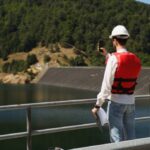
BC Hydro and independent power producers operate over 100 hydroelectric facilities across the province. Dam faces, intake structures, penstocks, spillways, and underwater gate seals all require periodic inspection under the Dam Safety Regulation and WorkSafeBC guidelines. ROVs allow operators to conduct these inspections during facility operation without dewatering structures or interrupting generation.
Reservoir inspection in particular has shifted heavily toward robotic platforms. Reservoir floor surveys, intake screen assessments, and trash rack inspections in large reservoirs are now almost exclusively conducted by ROV or robotic crawler rather than diver, driven by the combination of depth, zero visibility in many BC reservoirs, and safety regulations governing working depths.
Marine Terminal and Port Infrastructure
The Port of Vancouver, Port of Prince Rupert, and numerous smaller coastal terminals require regular inspection of piers, dolphins, mooring piles, fender systems, and underwater utilities. Transport Canada and the Canadian Standards Association publish inspection frequency requirements for federally regulated port structures. ROVs satisfy these requirements while avoiding the weather, tidal, and congestion constraints that complicate commercial diver scheduling in active port environments.
Municipal Water and Wastewater Infrastructure
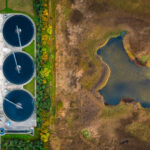
Metro Vancouver, the Capital Regional District, and municipalities throughout BC operate water intake structures, raw water mains, and outfall systems at depths and in flow conditions that make diver inspection difficult or impossible. Water Research Foundation studies have documented ROV inspection as both safer and more cost-effective than diver inspection for large-diameter water mains under operating pressure.
Confined spaces within water infrastructure, valve chambers, wet wells, clarifiers, and settling tanks, are a specific application where robotic inspection avoids the hazardous atmosphere entry requirements that govern confined space diving under WorkSafeBC Regulation Part 22.
Forestry, Mining, and Industrial Facilities
British Columbia’s pulp and paper mills, mine tailings facilities, and industrial process plants use large water handling structures that require inspection: cooling water intakes, process water reservoirs, clarifiers, and effluent holding ponds. Many of these environments combine confined space hazards with contaminated water, making diver entry inadvisable or prohibited. Robotic inspection services Vancouver operations that specialize in contaminated environment robotics are increasingly the standard solution for these sites.
What ROV Inspection Documents and Delivers
An ROV inspection scope is only as valuable as its deliverable package. Here is what comprehensive reporting looks like for structural underwater inspection in BC.
- Continuous HD video: Full survey video archived to client specifications, time-stamped and GPS-referenced. The baseline deliverable for any ROV inspection job.
- Annotated still imagery: Selected frames with defect markers, location coordinates, and condition grades. Used for maintenance prioritization and regulatory reporting.
- NDT data logs: Numerical outputs from UTM, CP potential measurements, or other sensor data formatted for engineering review and trending against previous inspection cycles.
- 3D models and sonar data: Georeferenced point clouds, bathymetric maps, or photogrammetric models for as-built comparison and structural deformation analysis.
- Inspection report: Written condition assessment referencing applicable Canadian Standards Association standards (CSA S6 for bridges, CSA W178 for welding quality, NACE SP0169 for cathodic protection) and clear recommendations for maintenance action.
When ROV Inspection Is the Right Choice vs. Commercial Diving
ROV inspection and commercial diving are not competing services. They are complementary, and the right choice depends on the specific task, site conditions, and applicable regulations.
Choose ROV inspection when: depth exceeds safe diver range, water visibility is below operational limits for diving, the asset is inside a confined space with atmospheric hazard, the site is within an active industrial process that cannot be isolated, or when continuous video documentation of the full surface is the primary deliverable.
Choose commercial diving when: the scope requires physical intervention (fastener removal, anode installation, cleaning before inspection), the task requires tactile assessment that sensors cannot replicate, or when site conditions favor diver efficiency over robotic deployment time.
Many BC infrastructure inspection programs use both in sequence: ROV for initial survey and condition screening, followed by commercial divers for targeted intervention at identified defect locations.
Frequently Asked Questions
Q: What are ROV inspection services in British Columbia?
ROV inspection services in British Columbia use remotely operated vehicles to inspect underwater infrastructure including bridges, dams, pipelines, marine terminals, and confined water structures. ROVs carry cameras, sonar, and NDT tools, and are operated from the surface in real time.
Q: How deep can ROVs inspect in BC waterways?
Inspection-class ROVs used in BC operations typically have depth ratings from 300 to 1,000 metres. Most infrastructure inspection in the province occurs at depths below 100 metres, well within standard ROV capability. Deep offshore work in the Strait of Georgia and Pacific coast environments may require work-class vehicles with greater depth ratings.
Q: What is the difference between ROV inspection and commercial diving inspection?
ROV inspection uses a remotely operated robot controlled from the surface. Commercial diving involves a trained diver physically entering the water. ROVs are preferred for deep, zero-visibility, confined space, or contaminated environments. Divers are preferred for tasks requiring physical manipulation or tactile assessment. Many inspection programs use both in combination.
Q: Are ROV inspections accepted by Canadian regulatory bodies for infrastructure compliance?
Yes. ROV inspection reports are accepted by Transport Canada, BC Safety Authority, BC Dam Safety Branch, and municipal authorities when conducted by qualified operators using calibrated equipment and delivered with appropriate documentation. Reports should reference the applicable CSA or NACE standard for the asset type being inspected.
Q: How long does an ROV inspection take for a typical BC marine terminal?
Scope, site conditions, and structure complexity determine duration. A single pier at a coastal terminal might be completed in four to six hours of ROV time. A large dam face survey with multibeam sonar and photogrammetry may take several days of mobilized operations. Mobilization, weather windows, and tidal restrictions also factor into total project timeline in BC coastal environments.